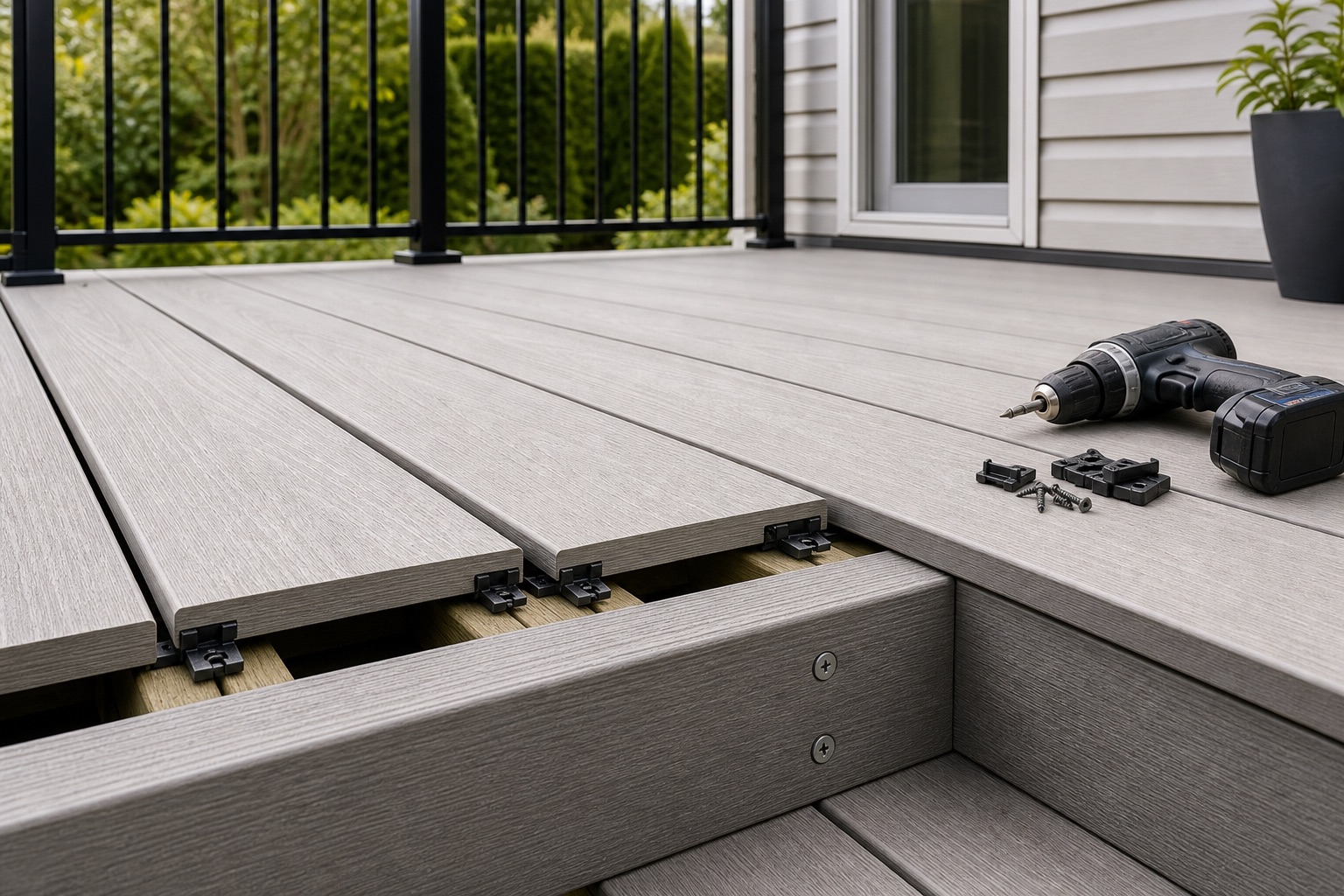
Understand what fasteners change
Fasteners are not only a technical detail. They affect the visible surface, board spacing, how a board can be replaced, and the time needed to create a clean finish.
On a composite or PVC deck, hidden fasteners often create a more uniform surface. Face screws still have a place in certain areas: borders, stairs, starter boards, repairs, or details where the framing requires more control.
- Look at where screw heads would be visible from the patio door and dining area.
- Confirm the fastening systems recommended by the board brand.
- Plan special areas such as stairs, borders, and fascia.
- Think about future repairs before choosing only by appearance.
Compare the common options
The best choice depends on material, board profile, budget, and desired finish level. Some boards are designed for clips in grooved edges, while others work better with visible or plugged fasteners.
A deck can also combine both approaches. Hidden clips may cover the main field boards, while face screws or plugs may be used at cuts, stairs, and finish details.
| Option | Benefit | Plan for |
|---|---|---|
| Hidden fasteners | Cleaner surface with fewer visible screws | Compatible clips, regular spacing, and precise installation |
| Face screws | Direct control and simple access | Visible heads and important colour matching |
| Screws with plugs | More discreet look on some boards | Installation time and finish details |
| Combination of systems | Good balance of appearance and control | Clear plan for borders, stairs, and repairs |
Think about borders and stairs
Large field areas are often the easiest place to use clips. Picture frame borders, stair nosing, fascia boards, and cuts around posts need more attention.
These areas should be planned early. Blocking, board direction, and fascia choices often determine where a visible fastener will be acceptable and where it may distract from the finished look.
- Define starter and finishing boards.
- Plan blocking for borders and stair nosing.
- Coordinate visible screws with board colour.
- Avoid improvising cuts around railing posts.
Consider future repairs
A very discreet fastening system can require more work when a board needs to be replaced in the middle of the deck. This is not a reason to avoid hidden fasteners, but it is worth understanding before construction starts.
Areas exposed to furniture, barbecue movement, or heavy planters may see more wear over time. A realistic fastening plan makes it easier to adjust if a board, border, or stair detail has to be replaced.
- Ask how a board in the middle of the deck would be replaced.
- Keep references for the fastening system used.
- Save a few boards or offcuts if the project allows it.
- Avoid fasteners that conflict with the material warranty.
Match the choice to the material
Composite, PVC, treated wood, and thermo-treated wood do not all behave the same way. Seasonal movement, heat, manufacturer recommendations, and board profile all affect fastener choice.
The right system is not universal. A clean finish starts with the material, then the compatible fastening system, spacing, and cut details.
Prepare the right questions
Before the estimate, explain the finish level you want. Do you prefer the most uniform surface possible, a simpler budget, a contrasting colour, or a solution that is easier to repair?
A good fastening plan is decided with the board choice, borders, stairs, and railings. The earlier these elements are discussed, the more coherent the final deck will feel.
- Ask which fastening system is recommended for the selected board.
- Confirm where screws will remain visible.
- Compare installation time between systems.
- Plan areas that may need repair access later.
Planning a deck on the South Shore?
Send your approximate dimensions, photos, city, and preferred material. We will help you compare realistic options before construction starts.
Request an estimate