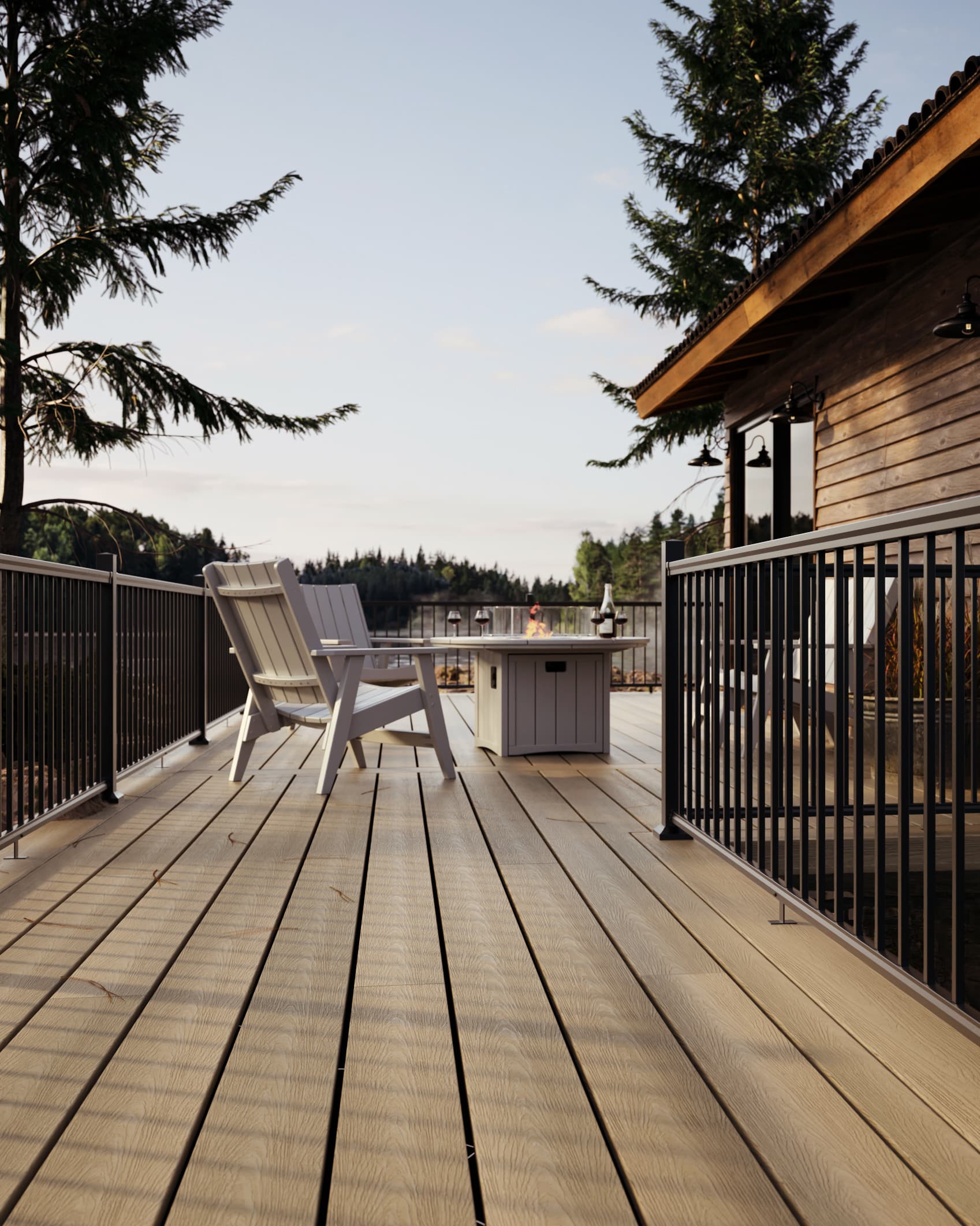
PVC vs composite at a glance
Composite and PVC decking are both designed to avoid the sanding, staining, and sealing required by wood. The biggest difference is inside the board: composite combines polymers with wood fibres, while PVC is made without wood fibres.
That difference affects weight, moisture resistance, thermal movement, feel underfoot, price, and installation details. Neither material is automatically better for every patio; the exact product collection and the quality of the installation matter just as much as the material name.
| Criterion | Composite decking | PVC decking |
|---|---|---|
| Core material | Wood fibres blended with polymers, usually protected by a cap | All-polymer construction with no wood fibres |
| Moisture resistance | Very good when the cap and board remain intact | Excellent because the board contains no wood fibres |
| Thermal movement | Expands and contracts; generally less movement than PVC | Usually moves more with temperature changes |
| Weight and feel | Denser, heavier, and often feels more substantial | Lighter and can feel slightly more flexible |
| Typical price | Available from value to premium collections | Often positioned in the premium price range |
| Warranty range | Varies widely by collection, commonly about 25 years to lifetime | Premium lines may offer lifetime product coverage |
Composition, appearance, and feel
Modern capped composite boards use a wood-plastic core covered by a protective polymer shell. The wood fibres add density and stiffness and can help reduce thermal movement. Many homeowners like the solid feel and the broad range of realistic wood-grain finishes.
PVC boards use polymers without organic wood filler. They are lighter, highly resistant to moisture, and available in detailed wood looks. Some PVC profiles sound or feel different underfoot, so it is worth walking on a full-size sample instead of choosing from a small colour chip.
Moisture, snow, and freeze-thaw conditions
PVC has the edge where constant moisture is the main concern because there are no wood fibres in the board. It can be a strong choice around pools, docks, shaded areas, and other locations that stay damp.
Quality capped composite also performs very well in Quebec weather when it is installed with proper drainage and ventilation. The frame below the decking still needs protection and airflow with either material; a moisture-resistant board does not make the entire structure waterproof.
- Keep the correct gaps so rain and melting snow can drain.
- Provide ventilation below the boards instead of installing them directly on a solid surface.
- Protect the wood framing and inspect areas where snow, leaves, or water collect.
Expansion and contraction: the installation detail that matters
Both composite and PVC boards expand and contract as temperatures change. PVC generally has more lengthwise thermal movement, while the wood fibres in composite help make its movement more moderate. On the South Shore, an installation may experience summer heat and deep winter cold, so these changes cannot be ignored.
The required end gaps, side gaps, joist spacing, fasteners, and fastening pattern depend on the manufacturer, product line, board length, and temperature during installation. There is no universal gap that is correct for every board.
A well-planned layout can also reduce visible movement. Breaker boards, picture-frame borders, properly supported butt joints, and manufacturer-approved hidden fasteners help control where board ends meet. Improvised fasteners or gaps can lead to open joints, buckling, loose fascia, and warranty problems.
- Use the current installation guide for the exact collection, not a generic rule.
- Measure and record the outdoor temperature during installation.
- Follow separate fastening and gapping instructions for fascia boards.
- Do not force long boards tightly against walls, posts, or other fixed objects.
How to compare warranties properly
Warranty terms vary by brand and collection. Residential product coverage can range from roughly 25 years to lifetime, while fade-and-stain protection may have a different term. A longer headline warranty does not necessarily mean that every repair cost is covered.
Most decking warranties are limited warranties. They may cover manufacturing defects or defined levels of fading and staining, but exclude improper installation, movement of the substructure, normal weathering, scratches, unusual heat sources, misuse, or failure to follow cleaning instructions.
Labour is especially important. Many standard warranties provide replacement material but do not automatically pay for demolition, disposal, freight, or reinstallation. Some manufacturers offer separate labour coverage only for eligible products installed by an approved contractor.
- Compare product-integrity and fade-and-stain coverage separately.
- Check whether coverage is prorated as the patio gets older.
- Verify registration deadlines, proof-of-purchase requirements, and transferability.
- Confirm whether labour, freight, removal, and reinstallation are included.
- Keep the invoice, product labels, installation guide, and photos of the completed work.
Heat, colour, and barefoot comfort
All decking can become hot in direct summer sun. Colour often has a greater effect than the broad material category: a dark board will normally absorb more solar energy than a light board from the same collection.
Some premium PVC and composite products use heat-mitigating technology, but no board stays cool in every condition. Compare full-size samples outside at the same time of day, especially for a south- or west-facing patio, a pool deck, or a space used by children.
Cost, structure, and long-term value
Composite is sold across a wide price range, from practical entry-level boards to premium collections. PVC is often priced toward the premium end, although the final difference depends on colour, profile, fastening system, availability, stairs, fascia, and railing details.
The decking price is only part of the project. Joist spacing, blocking, picture framing, approved fasteners, waste, and the complexity of stairs can change the installed cost. Choosing the least expensive board can be poor value if it does not suit the exposure or desired finish.
When composite is usually the better fit
- You want a dense, substantial feel similar to wood.
- You want more choice across entry, mid-range, and premium budgets.
- You prefer a product with somewhat lower thermal movement.
- The patio has normal residential exposure with good drainage and ventilation.
When PVC is usually the better fit
- Maximum moisture resistance is a priority.
- The project is near a pool, water, heavy shade, or a persistently damp area.
- A lighter board is useful for handling or a weight-sensitive application.
- You accept a higher material price for premium performance and warranty options.
The practical answer
Choose the collection, not only the category. Compare two or three actual boards based on colour, surface temperature, texture, installed price, written warranty, and the installation details required for your layout.
For many backyards, capped composite offers the best balance of appearance, price, and movement. For demanding wet locations or homeowners prioritizing maximum moisture resistance, PVC can justify its premium. In both cases, correct framing, ventilation, gapping, and fastening are what allow the product to perform as intended.
Planning a deck on the South Shore?
Send your approximate dimensions, photos, city, and preferred material. We will help you compare realistic options before construction starts.
Request an estimate